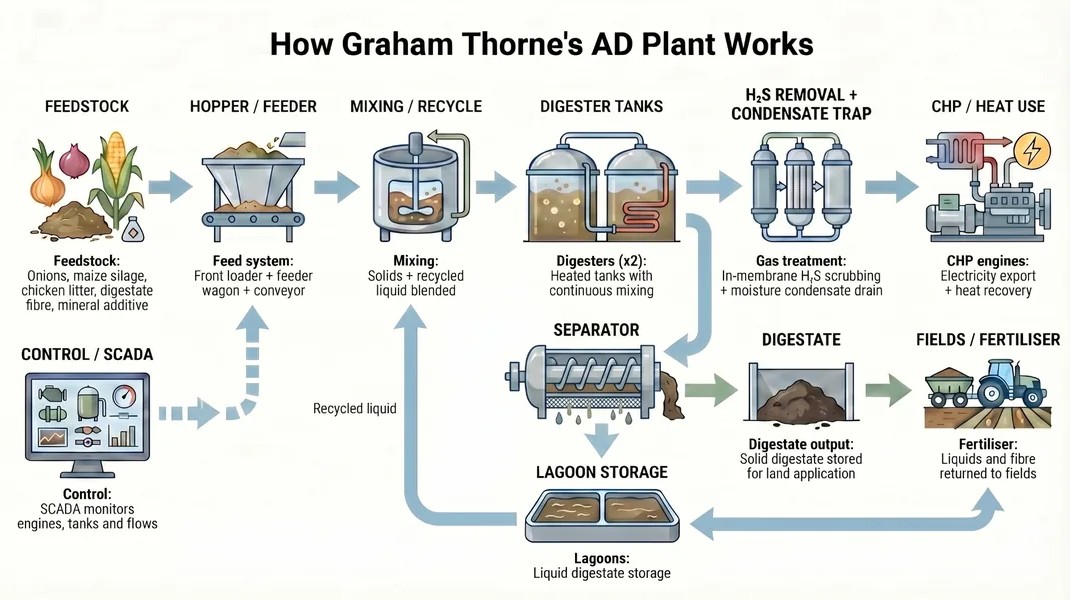
There is a particular kind of expertise that only comes from living with a technology for over a decade — fixing it in the dark, watching it fail, and figuring out why. Graham Thorne has that expertise. He built his anaerobic digestion plant from the ground up, starting in 2012, and on a grey February morning in Suffolk (such unusual English weather!) he walked me around every corner of it — from the feedstock yard to the control room — with the candid enthusiasm of someone who genuinely loves what he has made.
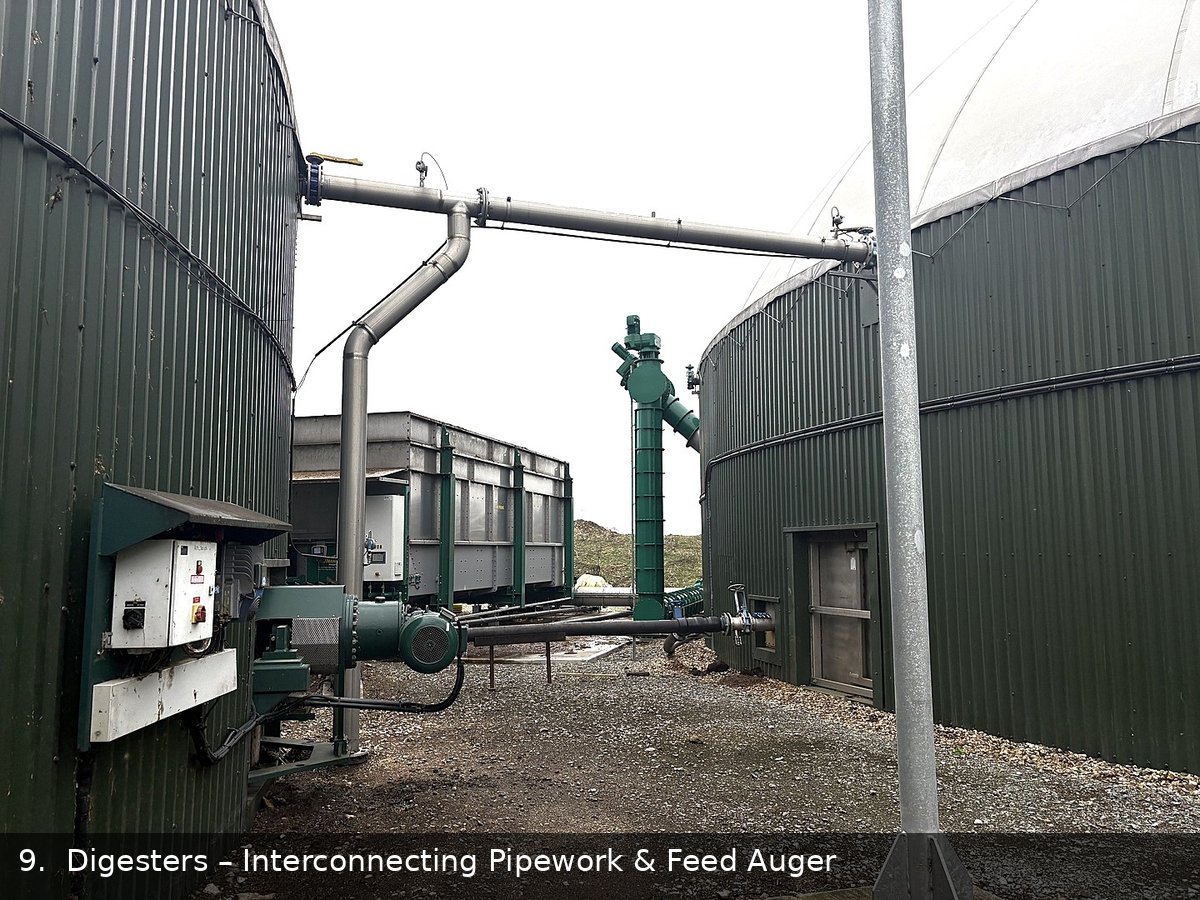
The plant sits on farmland outside the village of Stradbroke. You arrive expecting something industrial and agricultural at once, and that is exactly what it is. Stockpiles of maize silage, reject onions, chicken litter and mineral additives fill the reception yard. Two large concrete digester tanks dominate the skyline, their double-membrane domes sitting above ground like giant mushrooms, with another three metres sunk into the earth below.
"They're eight metres tall," Graham says, gesturing at the tanks. "Five metres above ground, three below. Ten inches thick — we poured these in situ. Incredibly solid bits of kit."
The feedstock strategy is where the science really lives, and Graham clearly relishes explaining it. Anaerobic digestion lives or dies on the carbon-to-nitrogen (C:N) ratio of whatever you feed into it. Too much nitrogen and the bacteria are overwhelmed by ammonia. Too little and the gas yield collapses.
"It's all about carbon:nitrogen ratios," he says. "If you get it wrong — too much nitrogen — it's just like acidosis in a cow. Sweet breath. The system goes off the boil."
His solution is elegant. He builds a stable, acclimated bacterial population in the primary tank using lignin-rich, carbon-heavy materials — maize silage, grass silage, oat husks — keeping the total ammonia nitrogen around 2,000 parts per million, which his bacteria have adapted to handle comfortably. Then he laces in the chicken litter.
"We poison it till we make it good poison," he says, grinning. "Because what we're doing, we push it virtually to the killing point. But the bacteria are flowing through, so in the second tank we can see how much chicken waste we can get into the system."
The result is a feedstock mix that handles around 35,000 tonnes of organic waste per year — much of it material that would otherwise have a disposal cost rather than a value. The reject onions, for example, arrive from local vegetable grading lines. "If we eat it, or a cow eats it, this can eat it," Graham says simply. I got the point, although my mind did conjure up disturbing images of chicken litter for dinner.
The two tanks operate in series — primary to secondary — giving a total dwell time of around 100 to 110 days. That long dwell time is deliberate. The plant was designed for cheap, slow-digesting materials with high lignin content, where the bacteria need time to work through the cell walls.
Inside each tank, three slow-speed mixing arms rotate continuously, day and night, driving the feedstock in a corkscrew motion that keeps solids in suspension and prevents the floating crust that would otherwise block gas collection.
"Very, very slow," Graham says. "The whole tank, with about 18 kilowatts of energy. Ultra slow. Continuous." He pauses. "That is my driver. The gas is sitting up top, and these arms are burying the crust and pushing it round."
The digesters run at 36–37°C — mesophilic temperature, which Graham acknowledges is cool by international standards. "We're quite cold in terms of AD," he says. "In your climate, you'd probably run them at 45, 47." But the long dwell time compensates admirably: at 100-plus days and consistent temperature, pathogen reduction is reliably achieved, making the digestate suitable for application to the surrounding cereal crops and grassland.
The biogas — running at around 52–53% methane after dilution, with 45–47% CO₂ — is collected under the membrane dome and pushed by a slight pressure differential down the gas train. The first treatment stage is biological: air is injected between the two layers of the digester membrane at less than 2% oxygen concentration. Bacteria living on the membrane straps oxidise the hydrogen sulphide.
"It's the cheap way of getting the H₂S out," Graham says. "If we weren't putting air in, we'd probably be running at 55, 57% methane. But because we're diluting, we're down at 52, 53. And the H₂S — basically, it's sulphuric acid. Whatever you put it in, it rots everything."
The gas then passes through a two-stage moisture removal system: first a condensate pipe where water drops out under gravity, then a cold-jacketed gas chiller that drives the temperature below the dew point, pulling out any remaining water vapour. "Moisture and engines don't go well together," Graham notes. The dried, partially treated gas goes directly to the CHP engines. There is no membrane upgrading, no grid injection — just robust, direct combustion.
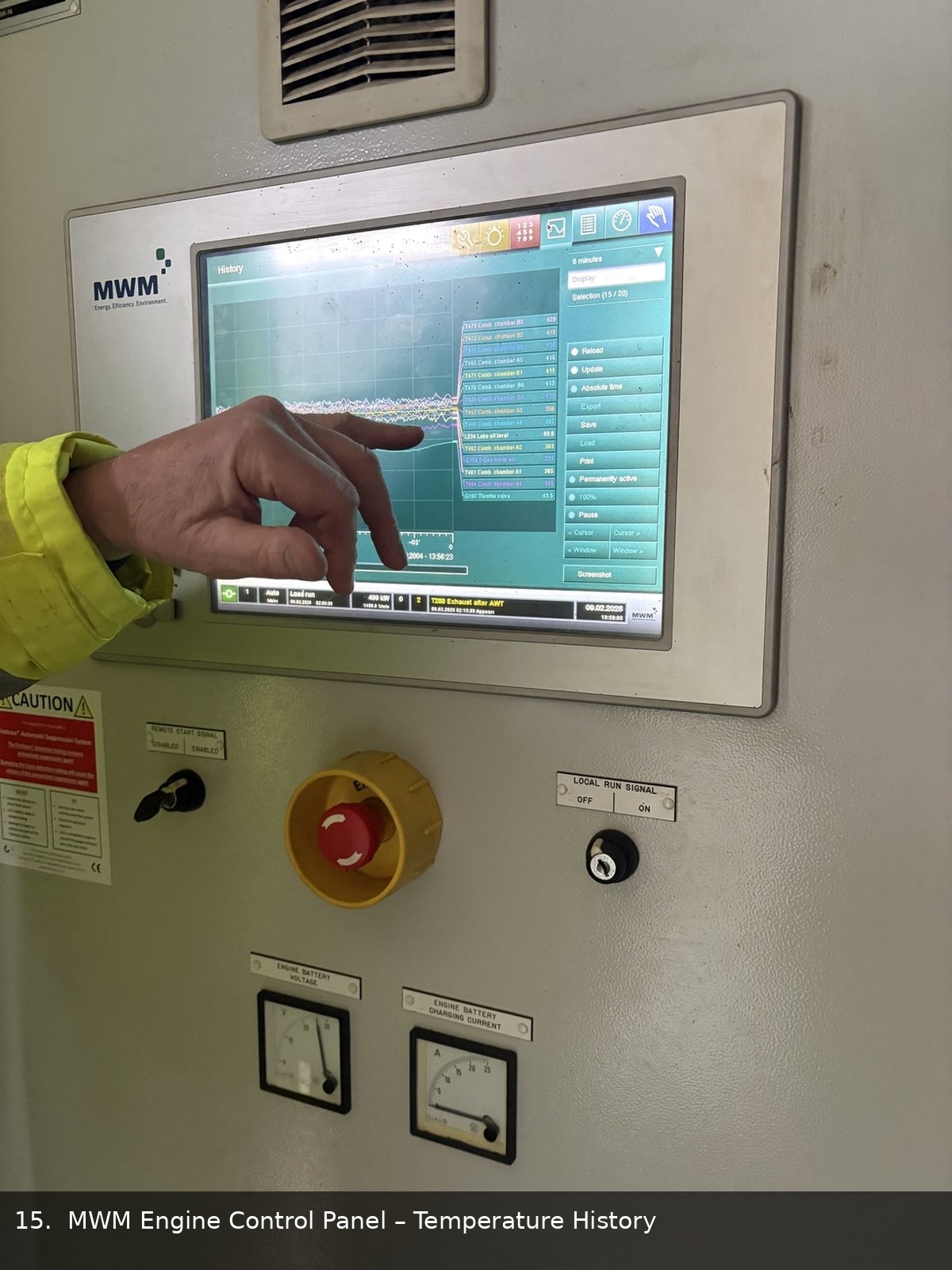
The CHP engines are MWM units — German-engineered, spark-ignition reciprocating gas engines from the same Mannheim engineering lineage that supplied auxiliary power units to German U-boats in the Second World War. "Big swept volume," Graham says admiringly. "Standard reciprocating engines. Pistons, rings, spark ignition. They're a great engine."
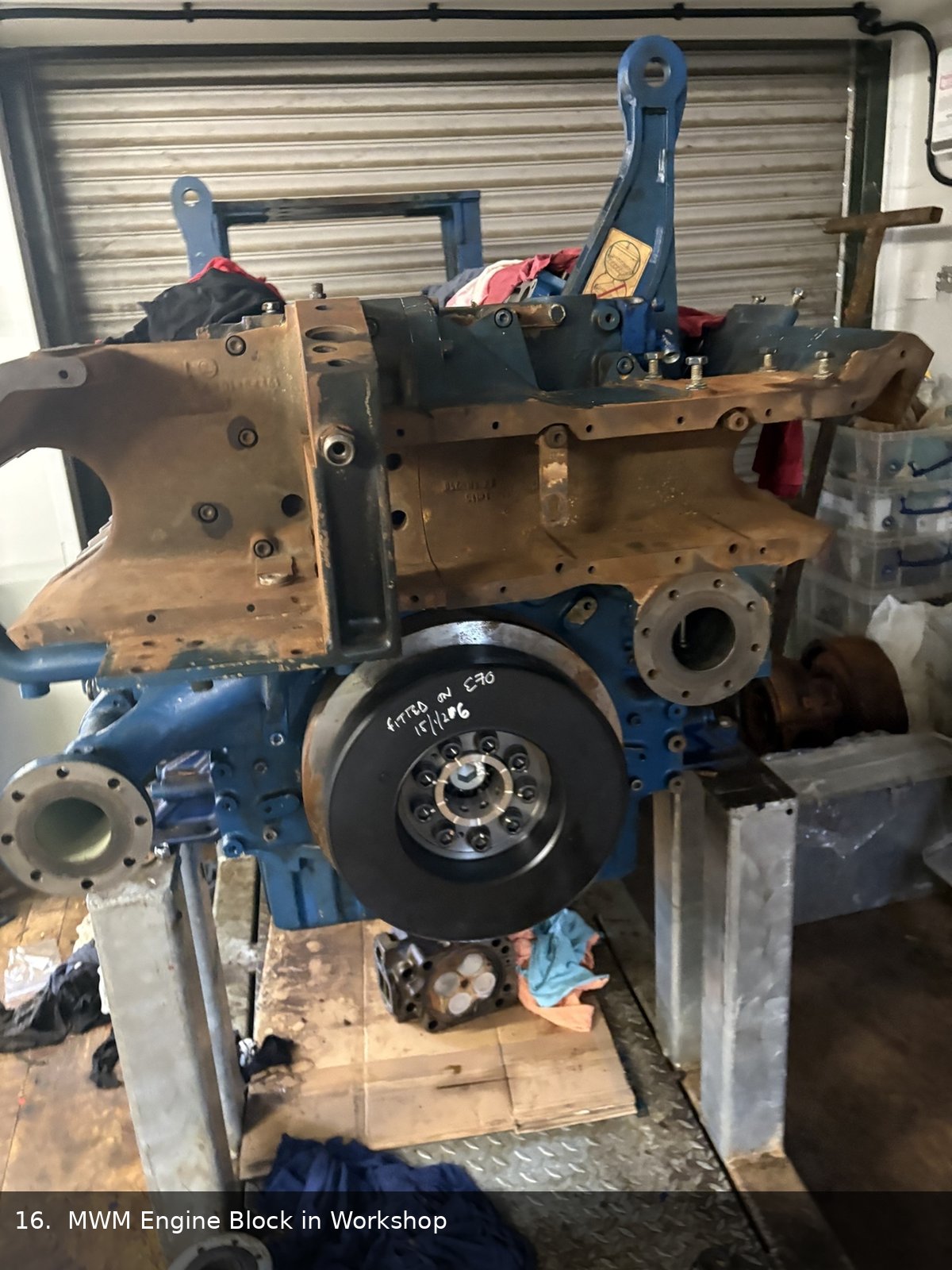
One engine has been running for twelve years. Twenty-four hours a day. Graham keeps a spare engine block on site and can complete a swap-out in three days. He does a full top-end rebuild once a year — two days' work, covering pistons, bearings, and heads — to manage the residual wear from H₂S.
The plant currently generates around half a megawatt of electrical output, exported to the grid at a commercial rate. Heat recovered from the engines is used to maintain digester temperature and feeds a 4.5-megawatt ground source heat pump system serving the farm buildings.
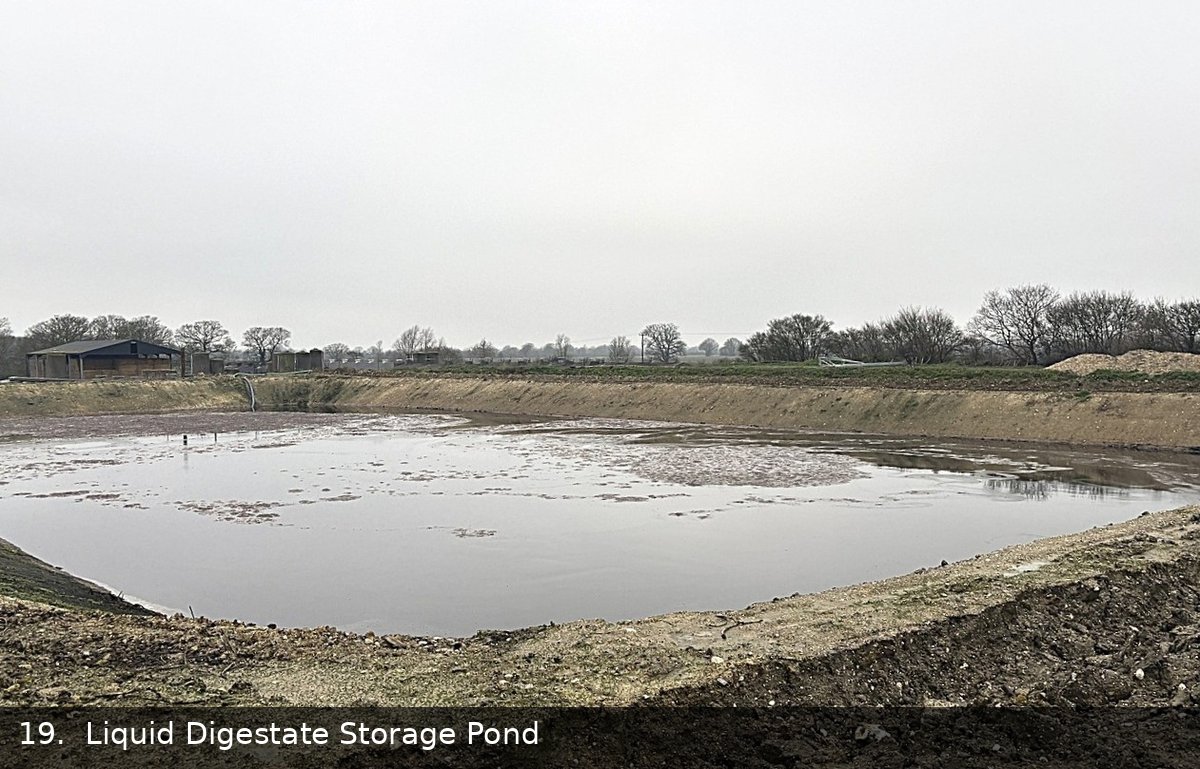
After digestion, the digestate passes through a Thöni screw-press separator, which splits the material into a solid fibre fraction and a liquid. The fibre is stored in a large open bunker — "really good stuff for growing," Graham says — and eventually spread on surrounding arable land as a slow-release organic fertiliser. The liquid fraction goes to storage lagoons: some is recycled back into the mixing system, and the rest is applied to fields.
The digestate cannot legally be applied to fresh vegetable crops in the UK because the feedstock includes animal waste. But on cereal crops and grassland, it performs well and has a measurable agronomic value. Graham is clear-eyed about this: in a landscape of intensive arable agriculture, a reliable supply of organic nitrogen is worth something.
Graham is thinking beyond electricity. With solar and battery storage making grid electricity increasingly competitive, he sees biomethane — clean gas injection or vehicle fuel — as the more defensible long-term market.
"My challenge is pivoting this business towards gas production," he says. "Clean gas. Gas clean gas production. It's a bit of a conundrum, isn't it — you need the electricity to pay the bills. But I don't think the future is electricity. To me, the future is gas."
He already has the feedstock, the digestion process and the gas handling infrastructure. The next step is upgrading — CO₂ removal, grid injection, perhaps vehicle fuel. The plant was designed with that optionality in mind. On a raw February morning, standing in the feedstock yard with onions on one side and a spinning digester on the other, it is easy to believe he can achieve anything he puts his mind to.








If you have a particular situation you would like to discuss, please get in touch.
Contact Cobalt 59